Showing posts with label class. Show all posts

Nov 17, 2026

The Wildborn - untamed children of the hinterlands

Wildborn sketch

The Wildborn

Prime requisite: None; no XP bonus or penalty from ability scores. Strength 13+ and Constitution 13+ are required.

Hit Dice: 1d12 (starting hp: 1d12  + Con adj.). A positive Constitution adjustment is doubled for every Hit Die.

Armor: Any, including shields. In leather armor or none, a positive Dexterity adjustment to AC is doubled.

Weapons: Any. Every wildborn learns the hand axe, dagger, and spear in childhood.

Beyond the last plowed field the old ways still hold. The Wildborn come from peoples who have never bent the knee to any crown: the Vandhir of the frozen north, the free tribes of the open plains, and the wild clans of the Chacutlai jungle. Their songs remember the tyrants of old, who used dark sorceries to enslave their ancestors, and they have not forgiven the injustices. A wildborn will take a priest's blessing and give thanks for it, but will break a wizard's wand over one knee and consider it an act of altruism. They are swift, hard to kill, and harder to fool, and in the old tongue they call themselves the Ferabarn. A wildborn speaks Common and a homeland tongue but cannot read or write until taught. A character of any ancestry may take up the life of the wildborn.

Wildborn Advancement

Level XP HD THAC0 (BHB)
1 0 1d12 19 (+1)
2 6,000 2d12 18 (+2)
3 12,000 3d12 17 (+3)
4 24,000 4d12 16 (+4)
5 48,000 5d12 15 (+5)
6 80,000 6d12 14 (+6)
7 150,000 7d12 13 (+7)
8 275,000 8d12 12 (+8)
9 500,000 9d12 11 (+9)
10 1,000,000 9d12+1 10 (+10)

BHB means Base Hit Bonus for ascending AC. The table covers levels 1–10 but is not a level cap. Each level beyond 10th requires twice the previous level's total XP (11th, 2,000,000; 12th, 4,000,000) and grants +1 hp.

Saving Throws

Level D W P B S
1–3 9 11 11 13 15
4–6 7 9 9 11 13
7–9 5 7 7 8 11
10+ 3 5 5 6 9

D: Death / poison; W: Wands; P: Paralysis / petrify; B: Breath attacks; S: Spells / rods / staves.

Special Abilities

Fleet Foot (1st level): Base movement is 150' (50'), and armor slows the wildborn by the usual steps, to 120' (40') in leather and 90' (30') in metal armor. Overland, the wildborn may travel at double the normal daily rate for three days, then must spend one day at normal pace. From a standing start the wildborn leaps 10' forward, 3' back, or 3' up. With a running start the leap is 15' + 1d6 forward or up to 6' high, and springing off a wall, tree, or ledge gains up to 7' of height.

Wildcraft (1st level): Each wildborn names a home terrain, such as steppe, forest, jungle, tundra, or mountain. Living a month in a new region makes it home terrain as well. Outdoors the wildborn follows tracks on 1–4 on 1d6, rolled once per hour or when the trail changes, with a penalty of 1 or 2 for rain, stone, or an old trail. The wildborn climbs trees, cliffs, and natural rock without gear, rolling only for a sheer, slick, or hurried climb and falling on a 1 on 1d6. Built walls of a given kind can be climbed the same way once the wildborn has practiced on them. Keeping still in natural cover, the wildborn hides on a 1 on 1d6, or 1–2 in home terrain, and each chance improves by 1 at 5th and 9th level. The wildborn hunts, traps, fishes, forages, builds shelter and fire, binds wounds, and sets bones, though in strange terrain the referee may limit what these skills provide. Each wildborn also knows two homeland crafts, chosen with the referee from animal handling, horsemanship, signaling by drum, smoke, or mirror, paddled boats, rowed and sailed boats, animal calls, and building pits and deadfalls for large game.

Wild Instinct (1st level): The wildborn surprises foes on 1–3 on 1d6, or 1–4 in home terrain, and is surprised only on a 1.

Sense Sorcery (3rd level): When the wildborn handles or studies an object, or comes within 10' of a place or spell effect, there is a 35% chance to sense whether it is magical, rising by 5% per level to 70% at 10th. The kind of magic is never revealed, and people who wield magic are not detected. Once per illusion or phantasm encountered, the wildborn has a 5% chance per level (50% at 10th) to know it for a lie, and a recognized illusion cannot harm them.

Blood of the Clans (5th level): When dealing with other wildborn and with the wild peoples they come from, the wildborn gains +1 on reaction rolls and retainers drawn from those peoples gain +1 morale. Both bonuses become +2 at 9th level.

Eyes in the Back (7th level): Any attack from behind, including a thief's backstab, is sensed on a 5% chance per level (35% at 7th, 50% at 10th). A sensed back attack becomes a normal attack, and the wildborn may at once make one melee attack against the attacker in addition to any other attacks that round.

Storm of Blows (9th level): Every second round of melee, the wildborn makes one extra melee attack.

Chieftain's Hall: At name level (9th) may raise a hall, camp, or hill fort in wild country, attracting warriors, hunters, scouts, and kin of the wild peoples. Must obtain and build the premises; neither the building nor a fixed number of followers is granted.

Magic Items

Wildborn will not knowingly use a magic item, and they destroy enchanted things whenever they can. An item whose magic they have not recognized works normally for them until they learn the truth. They accept priest spells of 1st to 3rd level as honest prayer but treat greater priestly workings as sorcery.


Nov 13, 2026

The Phantasmist - a master of deceit and glamour

The Phantasmist

The Phantasmist

Prime requisite: Intelligence and Dexterity. Dexterity must be 13+. Intelligence 13+ and Dexterity 13+ gives +5% XP; Intelligence 16+ and Dexterity 13+ gives +10% XP.

Hit Dice: 1d4 (starting hp: 1d4 + Con adj.).

Armor: None; no shields.

Weapons: Dagger.

The Phantasmist is a class of spell-casters who trade breadth of power for deception by specializing in the phantasm, glamour, darkness, and shadow. There are those who specialize in illusion magic in the frigid, gloomy land of Shaidan and who are known to be deceptive. The hands of the Phantasmists need to work as quickly as their minds because half the magic they do is deception. At their peak, they can turn their illusions into something tangible enough to draw blood from one who fully believes the illusion. A character of any race may take up the art of phantasm.

Advancement

Level XP HD THAC0 (BHB)
1 0 1d4 20 (+0)
2 3,000 2d4 19 (+1)
3 6,000 3d4 19 (+1)
4 12,000 4d4 18 (+2)
5 25,000 5d4 18 (+2)
6 50,000 6d4 17 (+3)
7 75,000 7d4 17 (+3)
8 110,000 8d4 16 (+4)
9 175,000 9d4 16 (+4)
10 350,000 9d4+1 15 (+5)

BHB means Base Hit Bonus for ascending AC. The table covers levels 1–10 but is not a level cap: each level beyond 10th requires twice the previous level's total XP (11th: 700,000; 12th: 1,400,000) and grants +1 hp.

Saving Throws

Level D W P B S
1–3 13 14 13 16 15
4–6 11 12 11 14 12
7–9 9 10 9 12 10
10+ 7 8 7 10 8

D: Death / poison; W: Wands; P: Paralysis / petrify; B: Breath attacks; S: Spells / rods / staves.

Spells per Day

Level 1 2 3 4 5
1 1 – – – –
2 2 – – – –
3 3 – – – –
4 4 1 – – –
5 4 3 – – –
6 4 4 1 – –
7 4 4 2 – –
8 4 4 3 1 –
9 5 4 4 2 1
10 5 5 4 3 2

Phantasmists keep a spellbook and memorize spells as magic-users do, drawing only from the Phantasmist spell list below. A starting phantasmist knows two 1st-level phantasmist spells.

Special Abilities

Trickster's Sleight (1st level)

Once per round as a free action, create a minor sensory trick within 30′: a faint sound, a smell, a hand-sized image, or a flicker of light. It lasts 1 round, causes no damage, and fools no one who touches or closely studies it. Useful for distraction; the referee may grant a surprise or reaction modifier of no more than 1.

The Knowing Eye (3rd level)

+2 on saves against illusions and phantasms. Once per illusion, when the phantasmist sees an illusion, they may roll a save versus spells to recognize it as false; success makes it harmless to them, and they may point it out to allies, who then each get a save to disbelieve.

Lingering Phantasm (5th level)

Illusions the phantasmist creates that last "while concentrating" persist for 3 rounds after concentration ends. The phantasmist may walk at half speed while concentrating on an illusion.

Phantom Double (7th level)

Once per day, as an action, create an illusory double of the phantasmist that lasts 1 turn and moves with them. Each attack against the phantasmist has a 50% chance to strike the double instead. A struck double vanishes. Area effects strike the real phantasmist.

Veil of Seeming (9th level)

Once per day, the phantasmist and up to six willing allies within 30′ appear as any creatures of roughly the same size and shape, for 1 hour. Onlookers who interact closely or have reason to doubt get a save versus spells to see through the veil. The veil ends for any individual who attacks.

Illusory Sanctum: At name level (9th) may establish a sanctum concealed by illusion, attracting apprentices, performers, spies, and suitable patrons. Must obtain and equip the premises; neither the building nor a fixed number of followers is granted.

Magic Items

Phantasmists may use: scrolls of phantasmist spells, or magic-user spells that appear on the phantasmist list; crystal balls (but not their ESP or clairaudience functions); wands of fear, paralysis, illusion, and magic detection; and magic items usable by all classes (potions, most rings, miscellaneous items without class restrictions). They may not use other wands, staves, or rods.

Phantasmist Spell List

Level 1

Change Self
Darkness
Detect Invisible
Gaze Reflection
Hypnotism
Light
Phantasmal Force
Read Magic
Wall of Fog

Level 2

Blindness
Deafness
Detect Magic
Fog
Hypnotic Pattern
Improved Phantasmal Force
Invisibility
Misdetection

Level 3

Continual Darkness
Continual Light
Fear
Hallucinatory Terrain
Invisibility 10′ Radius
Nondetection
Paralyzation
Spectral Force

Level 4

Confusion
Emotions
Improved Invisibility
Massmorph
Minor Creation
Shadow Magic
Shadow Monsters
Any one 1st-level magic-user spell (per slot)

Level 5

Chaos
Create Spectres
Demi-Shadow Magic
Demi-Shadow Monsters
Major Creation
Projected Image
Summon Shadow
Any one 2nd-level magic-user spell (per slot)

1st-Level Phantasmist Spells

Change Self Range: Self. Duration: 1d6 + 10 turns + 1 turn per level. The caster appears as any creature of roughly the same size and shape (a human could look like a gnoll, not a wyvern). Clothing and gear change appearance too. The caster gains none of the form's abilities. Touch reveals the true form.

Darkness Range: 120′. Duration: 6 turns + 1 turn per level. Fills a 15′-radius sphere with magical darkness that blocks normal sight and infravision. Cast on a creature's eyes, the victim saves versus spells or is blinded for the duration. Cancels a Light spell, and Light cancels it. 

Gaze Reflection Range: 80′ (self or one creature). Duration: 1 turn. An invisible mirror surface guards the subject's face. A gaze attack (basilisk, medusa, and the like) aimed at the subject does not affect it; instead the gazer must save against its own gaze.

Hypnotism Range: 80′. Duration: Until broken. One humanoid of 4 HD or fewer who meets the caster's eyes saves versus spells at −2 or is hypnotized. It regards the caster as a trusted friend and follows suggestions that are not obviously harmful to itself. It may save again each sunrise, and the effect ends if the caster or allies harm it. A creature that cannot see the caster's eyes is unaffected.

Wall of Fog Range: 160′. Duration: 1 turn per level. Creates an opaque wall of fog up to 60′ long and 20′ high, shaped as the caster wishes. It blocks vision but has no other effect; creatures move through it freely. 

To be continued...

Aug 23, 2024

Dwarf Crafter - an Original Edition Class


The Dwarf is severely limited in the original edition. It is restricted to the Fighting-Man class and can only rise to 6th level. They get a small number of interesting abilities that are acutely geared toward the sort of dungeon delving that was most popular in the early days of the game (and is still the best fun, in my opinion). While it does not explicitly associate race-as-class like the later Basic editions did, it was implied because they could only be the one class. Taking that idea and extrapolating it further here is a Dwarf class that is explicitly specialized at being a Dwarf.

The original Dwarf clearly drew inspiration from Tolkien, who in turn took his inspiration from Norse mythology. In that mythos there is little difference made between Elves (or Alfar as they are called) and Dwarves (or Duergar). Perhaps oversimplified, but the elves were light and lived in Alfheim, the dwarfs were darker and lived in Svartalfheim. They were semi-magical beings with the ability to craft wondrous items with powerful magical qualities. It makes sense then, that the original edition dwarf would have some magical crafting abilities.

In this version there is no limit to the level a Dwarf may attain, this is balanced by other factors.

DWARF CRAFTER 
An Alternate Original Edition Class
Prime Attribute: Strength, 13+ (+5% XP), 15+ (+10% XP)
Hit Dice: 1d8
Armor/Shield Permitted: Any.
Weapons Permitted: Any.
Languages: Gnome, Kobold, Goblin, Dwarf, Common
Dwarfs are at once Fighting-Men and Craftsmen of the finest sort. The quality of their metal work is legendary. 
Dwarfs emerged from the decomposing corpse of Ymir, the first frost giant. They were born without any distinguishable form or intelligence. Disgusted by their looks, the gods transformed them into a more human form and bestowed upon them a very high level of intelligence, and tremendous skill in crafting items of beauty and wonder.
Dwarfs are dour and stoic, and have a reputation for greed because gold and finely crafted art are their only true joys in life.
All dwarfs are of stocky build and have very broad shoulders. Their general complexion and size depends on their type; hill, mountain, or burrower:

Hill: these ruddy tan skinned dwarfs are about four feet tall and weigh around 175 pounds. This is the typical and most common dwarf.

Mountain: these brown skinned dwarfs are about four and a half feet tall and weigh around 200 pounds. Largest and most boisterous of the dwarfs, they are also not as common.

Burrowers: these gray skinned dwarfs are just under four feet tall and weigh around 150 pounds. Rarely seen on the surface world these reclusive dwarfs are known to delve in the deepest subterranean depths.

Dwarf Crafter Statistics


Dwarf Crafter Saving Throws
*Dwarfs generally save vs. spells at 4 levels higher.

Dwarfs are agile and rugged for their short stocky size. They have a knack for frustrating very large foes in combat thus they only take ½ damage from Giants.
Dwarfs are generally not adept at learning the complexities of spell casting, but they do have a natural ability to resist the effects of magic. This innate Magic Resistance gives them excellent saves vs spells (+4 levels, as already noted on the Saving Throw chart).
Dwarfs are the finest crafters in the known world and can forge weapons, armor, and other items to the highest levels of craftsmanship. Any item crafted by a dwarf has x4 base value and readily takes enchantment. They are the only beings able to craft and wield +3 Magic WarHammers.
A dwarf notices immediately if a surface they are traversing on is an inclined plane. 
The keen eye of a dwarf for craftsmanship and manufacturing gives them a bonus to detect traps, note shifting walls, and notice any new construction underground. 1-2 on d6.
Their keen eyesight extends into the ability to see in the absence of light, thus they have infravision and can see monsters up to 60’ away in the dark.
Goblins & kobolds are a dwarf’s natural (and most hated) enemies, and Dwarfs will attack them before any other enemies in sight. The dwarf gets a +1 bonus to hit when fighting these creatures.

Dwarfling
Optionally the Referee may permit the Dwarf character to begin as a 0 level Dwarfling. They will have 1d6 hit points, +0 Attack Bonus (or fight as a Man), and have saves as 1st level.

Jan 24, 2024

Valkyrie Character Class

This is a new NPC class in the OSR Book of Valkyries. It is designed for demi-goddesses, so a bit overpowered compared to a regular character class.

Valkyrie

Prime Attribute: Wisdom, 13+ (+5% XP).
Attribute Requirement: 17+ Charisma
Hit Dice: 1d10.
Starting Hit points: 10 (1d10).
Armor/Shield Permitted: Any.
Weapons Permitted:  Any.
Alignment: Any but Evil.

A Valkyrie is chosen by Odin. Only a virgin human woman is given this honor. In rare circumstances Odin may choose a female duergar (dwarf), an elf, or even a Jotun. She is empowered by the All-Father with certain gifts and responsibilities. 

If a Valkyrie is slain while performing her duties she is resurrected and fully recovered in Valhalla the next day.

Valkyrie Statistics

Bifrost Travel: At will the Valkyrie can instantly travel the Bifrost rainbow bridge from any place on Midgard to Asgard and back. She can carry one person with her.

Spells: At 2nd level the Valkyrie is given a draught from the Mead of Poetry, wherein she gains the power to learn Seidr up to the 4th circle (level). She may choose from the Magic-User list.

Unseen: The Valkyrie is effectively invisible to mortals unless she chooses to be seen. She can be detected by means of seeing the invisible such as a Ring of True Sight or See Invisibility spells.

Swan Suit: At 3rd level she is given her Swan Suit that allows her to transform into a swan at will. Some Valkyries may be given a hawk or raven suit instead.

Helm of Truesight: At 4th level she is given a helmet that has the power of truesight.

Horn of Calling: At 5th level she is given a horn that will allow her to call other Valkyries, Einherjar, or Sturmwolves to her aid.

Winged Horse: The 6th level Valkyrie is given a winged horse from Valhalla’s stables personally by Odin.

Extraordinary Beauty: The Valkyrie gains +5 to Charisma.

Fylgur: At 8th level Odin may give a Valkyrie a personal spirit companion (see below).

Personal Hero: At 9th level the Valkyrie gets a personal hero she is responsible for, but who will also do anything for her up to and including giving his life. If she falls in love and marries him she loses her status and abilities as a Valkyrie and becomes, once again, a mortal woman.


Fylgja 

A fylgja, meaning "follower," is a magical spiritual companion typically appearing as a small animal (such as a fox, squirrel, or raven) that is usually visible only to the person it accompanies, in this case, a Valkyrie. However, the fylgja or the Valkyrie can choose to make it visible to others. By focusing, the Valkyrie can perceive through the fylgja's senses, including sight, hearing, and smell. If the fylgja is injured, the Valkyrie will feel its pain but may not necessarily suffer any physical harm. The fylgja's personality mirrors that of its Valkyrie.

Each fylgja possesses the standard characteristics of its animal type along with one of the following abilities:
  1. Aura of fear - Projects an intimidating presence to ward off adversaries.
  2. Protection from Evil - Shields the Valkyrie from malicious forces or beings.
  3. Purify food and water - Removes impurities and contaminants from sustenance.
  4. Cure disease - Heals the afflicted of various ailments.
  5. Cure light wounds - Mends minor injuries.
  6. Precipitation - Manipulates weather to cause rainfall.
  7. Gust of wind - Generates a strong gust to repel or disperse objects or creatures.
  8. Remove poison - Neutralizes harmful toxins in a person or object.


Mar 7, 2023

Barbarian Kid Character Class


 In the Saturday morning cartoons of the 70's and 80's there was a character archetype you could call the "Barbarian Kid". Examples include Bamm-Bamm Rubble, Prince Dorno, and of course Bobby the Barbarian from the classic Dungeons and Dragons cartoon. What would this look like as a character class for OD&D or B/X? Here is a rough write-up of what he could be.

BARBARIAN KID Prime Attribute: Strength, 13+ (+5% XP) Hit Dice: 1d10 Armor/Shield Permitted: Any non metal. No shield. Weapons Permitted: Any. Club is preferred (+1 to hit) Save: as Fighter class

Barbarian kids are unusually strong children with fierce attitudes, a primitive weapon, and a pet. 

The barbarian kid has somewhat stunted growth, appearing to age slower than others of their kind, and being generally more diminutive. Though at some point they may have a growth spurt around late puberty and grow much taller, larger, and more muscular than is typical of their kind. 

They are highly suspicious of magic and as a general rule will avoid using magic items, except in some circumstances such as being given a magic club.

They will never willingly retreat, surrender, or take prisoners.


Level

Title

XP

Class Ability

Hit Dice

d10

BHB

Fighting Capability

1

Barbarian

0

Berserk, +1 Str

1

+1

Man +1

2


2000

Pet

2

+2

2 Men +1

3

Fighter

4000

Impervious

3

+3

3 Men or Hero -1

4


8000

+1 Str

4

+4

Hero

5

Warrior

16000

Speed Burst

5

+5

Hero +1 or 5 Men

6


32000


6

+6

Hero +1 or 6 Men

7

Drengr

64000

Bonus attack

7

+7

Superhero -1

8


120000


8

+8

Superhero

9

War Lord

240000

+1 Str

9

+9

Superhero +1

10

War Lord, 10th

480000


9+1

+10

Superhero +1


The barbarian kid is unusually strong and gets +1 strength at 1st, 4th, and 9th levels. This may exceed normal race limits.

Barbarian kids also get a +4 bonus to any saving throws vs. any kind of fear (magical or non magical).


Berserk Trigger: This is a small trigger that puts the Barbarian Kid into berserk rage. This is chosen by the GM during character creation and can be a word, a particular food or smell, an action, or any other common thing that may come up in the adventure. When triggered the barbarian kid goes into a berserk rage and gets +2 to all attack rolls, +2 to damage, and -2 to AC. Also they shrug off 1pt of damage from each hit they take. Berserk rage lasts 2d6 turns, and then the barbarian kid is exhausted for 1 hour for each turn they raged.

Pet: Every barbarian kid befriends a cute pet that is semi-intelligent. It is equally useful and not, depending on the situation. It may get in trouble, cause mayhem, or get in the way. Then it also may save the day by fetching the keys hanging on the guard’s belt when the barbarian kid is locked up. They are loyal to the barbarian kid to death and may be very dangerous to strangers, and even friends, as it is extremely protective.

Roll 1d6

  1. Baby unicorn

  2. Baby dinosaur

  3. Baby saber-toothed tiger

  4. Baby dire wolf

  5. Baby cave bear

  6. Baby griffon

Impervious: At 3rd level the barbarian kid chooses one damage type that they are practically impervious to. This can be fire, poison, blunt damage to the head, or something else. The GM must approve this. The barbarian kid reduces the amount of damage taken this way by 1 point per incidence and +4 to saving throws vs that damage type when a save is called for.

Speed Burst: At 5th level the Barbarian Kid gains +10' to their speed during encounters.

Bonus attack: At 7th level the Barbarian Kid gains an extra attack each round, if using their preferred melee weapon.


Aug 1, 2022

More Options for Clerics

 The cleric is one of the most interesting additions to the original edition of DnD.

In many ways the militant holy man is a bit of an odd fit among the general swords & sorcery genre that informed the early development of the game. There is really nothing quite like it among the works of Edgar Rice Burroughs, Fritz Leiber, Robert E. Howard, JRR Tolkien and so on. Even CS Lewis doesn't have anything resembling the Cleric anywhere in the Chronicles of Narnia.

We have to dig back into history and lore to find warrior monks. Friar Tuck, the orders of Knighthood like the Templars, and further back perhaps to Old Testament times with some of the Judges of Israel. The most likely inspiration was Dr. Van Helsing, particularly as he was portrayed in the Hammer Horror films that Gygax and Arneson enjoyed so much.

While you could argue that the entire booklet Gods, Demigods, & Heroes is specifically for the Cleric, the class itself is a bit neglected in the early Little Brown Books. The Monastic Knights class treatment I made a while back was an attempt to fill that gap. Though with that class my intention was to revise the cleric from less of a priest and more into a holy warrior. A niche between clerics and paladins. A less restrictive paladin if you will. 

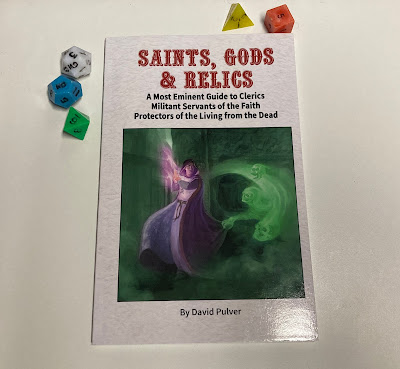
I was having this conversation with David Pulver about the cleric and he mentioned he had written an entire treatment for the Cleric for his homebrew campaign. I was immediately intrigued and we soon agreed to publish it as an OD&D supplement. That was two years ago.

This project has been sitting on my backburner that long. I'd pull it out dabble with it, work on layout, and sketch some art, then put it back. I'm sure David was wondering if it would ever get made. Well, that time has come. It is a book that fleshes out the cleric class without breaking game balance. We'd joked that we could call it Old School Religion, OSR if you will, but ultimately Saints, Gods, & Relics was a more fitting title.

The book is now available in PDF & Print, and as a bundle.

https://www.drivethrurpg.com/product/401377/Saints-Gods-and-Relics